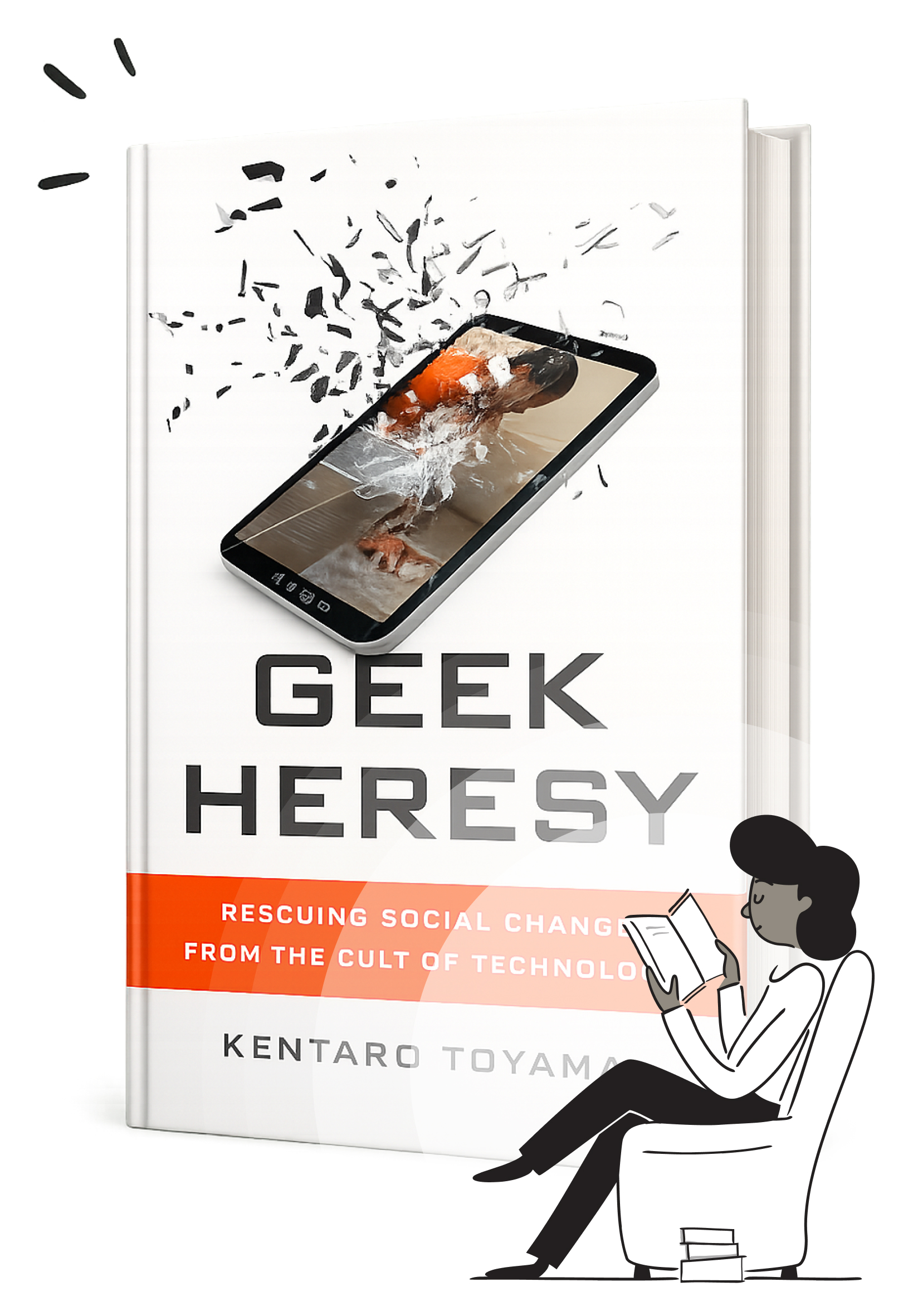
Geek Heresy by Kentaro Toyama
Well-intentioned technology doesn’t always solve the problems it’s meant to address. Toyama explains why, and tells us what we should do instead.
By Kane Lincoln

Most technologists I’ve met are optimists. We tend to think the work we do has a positive impact on the world and we tell ourselves stories about how the next product we build will unlock X amount of growth, or empower Y people to live healthier lives. These stories are easy to believe, in part because they reflect a reality that we can see all around us. For instance, well-designed banking software has made it easier for us to manage our money, and better-designed video conferencing software has made collaboration in teams easier.
In Geek Heresy, Kentaro Toyama makes clear that no hard problem can be solved by technology alone. In fact, some of our core beliefs about technology’s outsized impact on prosperity and progress, many of which Toyama succumbed to himself while working at Microsoft, are completely misguided and miss the point. What Toyama makes very clear is that systemic problems can only be solved through systemic solutions.
First published in 2015, Geek Heresy today is as relevant as ever — we think it is required reading for any technologist working on a hard problem, whether that’s climate change, global public health, or anything in between.
Technology is no panacea
Toyama spends “Part 1” of his book arguing that technology is not, in and of itself, a solution to big problems. For some of us, this may seem an obvious insight. Less obvious, though, are the reasons why. Toyama helpfully guides us through a set of fallacies that he calls the “Tech Commandments.” They are a set of common mistakes about tech, held by those technologists.
A good example that Toyama focuses on is the One Laptop per Child (OLPC) program. In about 2004, OLPC was a darling of the technology world. It was a well-meaning and ambitious initiative to design affordable laptops that could be sold to developing countries “a million units at a time.” Originally billed by its founder, MIT’s Nicholas Negroponte, as a project to improve education (“it’s not a laptop project”). The basic idea was that if poor students had access to decent-enough computers and the internet, they would be able to pull themselves out of poverty. Toyama pulls no punches when describing OLPC’s failings: “Three months after an enthusiastic nationwide rollout in India, the novelty factor had worn off, and each week saw less use of the laptops. Even after 15 months, students gained nothing in academic achievement.” Though admirable in its mission, Negroponte’s desire to do something that could scale to millions of people was ultimately misguided. “Low-cost technology is just not an effective way to fight inequality,” Toyama affirms, “because the digital divide is much more a symptom than a cause.” This is just one strong example in this book where technology-first solutions fail to make an impact on systemic challenges.
If you work in Big Tech, you might think that the sheer scale at which you operate means that what you design, build, or otherwise contribute, can positively influence human behavior en masse. In some ways, that’s true, but we should not equate altered behavior with fundamental change, which is something technology alone cannot achieve. If you were working at Facebook in 2008-2009, you may have thought that what you’d built had given rise to the Arab Spring (sometimes dubbed the “Facebook revolution”), a genuinely historic event. In reality, revolution does not happen via social media, and Toyama’s “Law of Amplification” tells us why.
The “Law of Amplification” — possibly the most important idea in the book — describes technology’s role in reinforcing, rather than materially changing, existing behavior. Regarding the Arab Spring, Toyama concedes that in Tunisia and Egypt, social media did play a role in regime change, but in countries like Bahrain and Saudi Arabia its effects were much more muted. Why did technology have an impact in one case but not the other? Drawing out the pre-existing differences between these polities and their institutions, Toyama argues that in Tunisia and Egypt, “leaders of the rebellion saw their organizing power extended by social media,” whereas in Bahrain and Saudi Arabia, civil society had been crippled for decades, “so no amount of Facebook organizing made a difference.”
Toyama also relates the Law of Amplification to a phenomenon we’re all familiar with: digital echo chambers. “Online, you can find self-reinforcing groups of white supremacists on one hand,” he writes, “and free-loving hippies on the other.” Instead of bringing everybody together, Toyama argues that the Internet has taken an existing preference — the fact we enjoy spending time with people who share our interests — and merely amplified its effects.
“Technology’s primary effect is to amplify human forces. Like a lever, technology amplifies people’s capacities in the direction of their intentions.”
— Kentaro Toyama
Toyama concludes that technology cannot by itself lead to positive outcomes. In order to actually achieve that, we need to combine technology with thoughtful and effective human relationships.
It’s not about the tech. It’s about heart, mind, and will.
If the first half of his book is a scathing rebuke of the Silicon Valley approach to solving hard problems, the second is a prescription for how we ought to think about technology if our goal is to affect real change. In this section, Toyama communicates two key messages:
- Effective use of technology consists of three rules: identify the human forces that align with your goals, use packaged interventions (which includes technology) to amplify the right human forces, and avoid indiscriminate dissemination of these packaged interventions.
- It’s only through a combination of “heart, mind, and will” that we can ensure our solutions really move the needle and deliver impact.
Digital Green, an organization that supports Indian smallholder farmers through the provision of online how-to videos, is a good illustration of the first.
Toyama lays out how “offering videos to poor, non-literate farmers is largely meaningless by itself” but that Digital Green’s effort to feature local farmers in each video made a key difference. How? Prior to Digital Green, a nonprofit called Green Foundation performed “agricultural extension” (training for farmers) through in-person tuition. Digital Green created how-to videos based on Green Foundation’s thoughtful material and understood that the farmers they wanted to connect with could be “swayed by in-person interactions with peers.” Green Foundation’s training had been delivered via human-to-human extensions, and Digital Green’s videos amplified those interactions “by making them more memorable and enabling more of them at once.” In the end, Digital Green “caused seven times more adoptions than classic [human-to-human] extension, and it was 10 times more cost-effective.”
If we map Digital Green’s approach to Toyama’s three rules for effective use of technology, we see that:
- Green Foundation came long before Digital Green and had already committed to supporting farmers. Existing human forces that provably worked aligned with the goals of the project.
- The founder of Digital Green took what Green Foundation was already doing and used technology to amplify it. Ensuring each video featured a person the farmers could relate to retained enough of the human-to-human feel to make the project work.
- Digital Green has not overstepped and applied the same technique to other problem areas. Rather than turning to another worthwhile cause, Digital Green acknowledges that it is only as good as its partner content and cannot infinitely scale to address every important problem.
Digital Green’s videos have been watched by over 400,000 people in over 5,000 villages. Clearly, the project has been a success.
There is hope to make a difference
Toyama’s second message is one of hope. If we want technology to make a difference, we need “heart, mind, and will.” Good intentions (heart), thoughtfulness and discernment (mind), and self-control (will) are themes that Toyama constantly returns to, relating them to the people behind organizations that successfully affect positive change (just like Digital Green). I tend to agree with his assessment. Engineers and designers can use their knowledge of technology to lift communities out of poverty, bring high-quality education into classrooms, and much more.
Toyama embodies this belief himself: he is a former Microsoft researcher who woke up one day and realized he wasn’t doing the type of work he wanted to do (he’d originally entered science to deal with energy crises after experiencing these kinds of shocks in the 1970s). He jumped at the opportunity to launch the Microsoft Research Lab in India and it was through this experience that he discovered just how little technology can help in the face of hard, structural problems.
In the end, Geek Heresy challenges us to look inwards and reflect on the real, tangible impact of the work we do. “Any progress worthy of the name requires progress in human heart, mind, and will,” so we should not overestimate technology’s ability to make the right things happen without strong stewardship, led by humans.
Today, we seem to be staring down the barrel of what is being billed as a transformative technology: AI. Will it lead to abundance or destruction? A less equal or more egalitarian society? In light of questions like these, we’d do well to take Toyama’s parting message to heart: “Technology doesn’t bootstrap an ethical outlook on its own.” When it’s all said and done, people govern technology, and that is what we must keep in mind if we hope to use it to change the world for the better.