Moral Ambition by Rutger Bregman
This book offers a timely provocation for those of us seeking to center our professional lives on problems that matter.
By Kane Lincoln

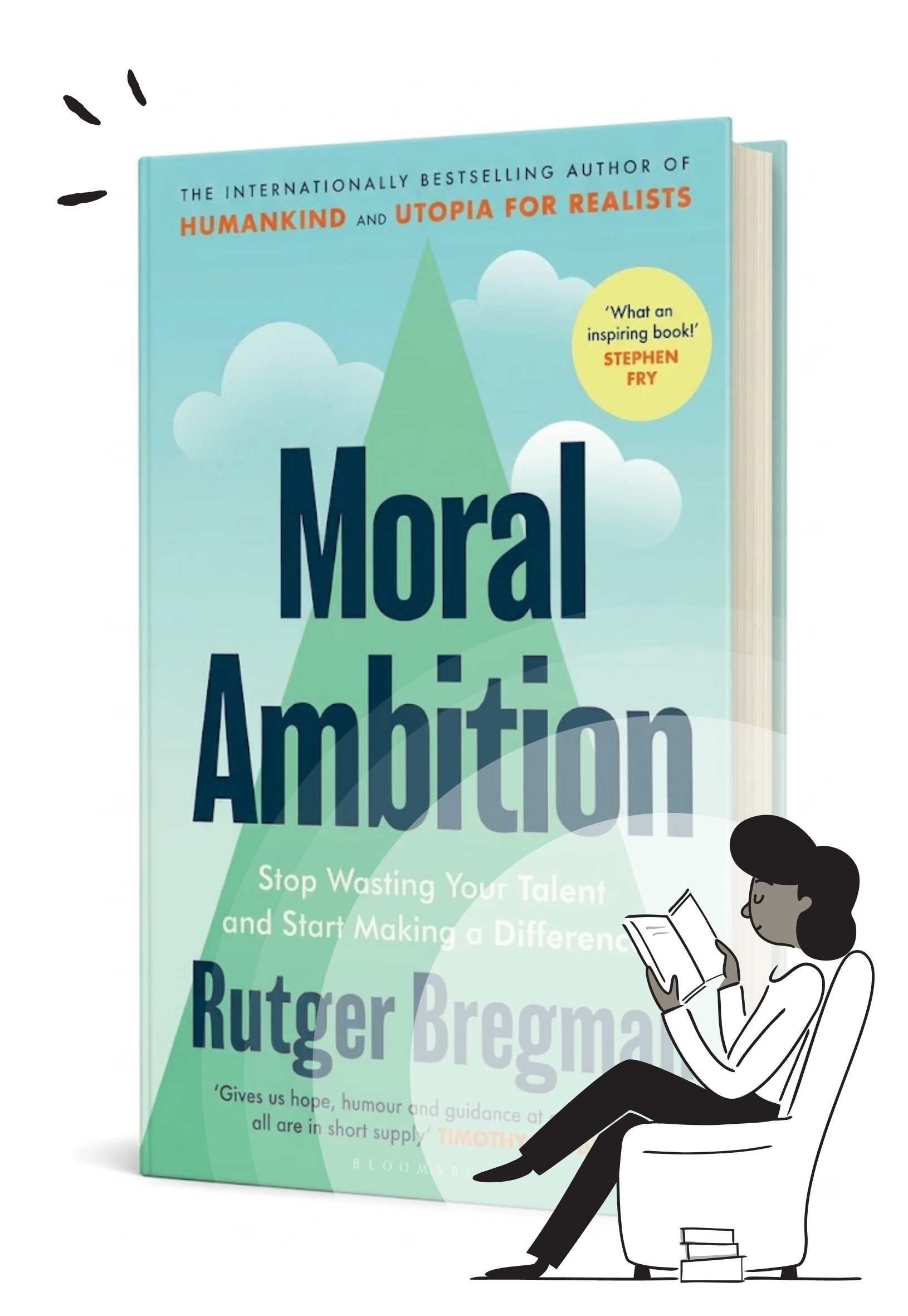
“There are millions of people around the world who could help make [it] a better place, but don’t,” writes Rutger Bregman. In his latest book, Moral Ambition, Bregman makes a compelling case for working on the types of global challenges we’re obsessed with at Hard Problems.
We like this book as a clarion call for people with skills, like designers and technologists, to do something to change the world for the better. For those of us who are still thinking about how to orient our careers around impact, there are important lessons we can learn through Bregman’s analysis:
- If you’re starting to question the impact of your work, you aren’t alone.
- Yes, individuals can change the course of history.
- We need new strategies for winning the moral argument.
Let’s take each of these in turn.
If you’re starting to question the impact of your work, you aren’t alone
According to recent research (helpfully synthesized by Bregman), “about 8% of all employees think their own job is pretty pointless” and another “17% confess to having some doubts about whether their job contributes to society”. Evidently, many of us feel disenchanted with the work we do. To add insult to injury, Bregman is quick to point out that those of us “with the world at [our] feet”, who’ve had “the power to shape [our] own careers”, often get stuck in “mind-numbing, pointless” jobs.
Fortunately, Bregman offers a response: moral ambition. He describes it as work that is both ambitious and idealistic, and argues that it provides us with “a deeper form of freedom” born out of a desire to make the world a better place. People who are morally ambitious work on big problems, he tells us, because scale matters. As such, idealistic but unambitious work gets short shrift as far as Bregman is concerned. While some might bristle at this feature of his thesis, Bregman notes that even the well-intentioned can end up “more preoccupied with the kind of work they do than with the impact the work has”. Bregman urges those of us who feel a tension between the work we do and the extent to which it affects change to seriously consider whether we’re making the most of our talents.
Yes, individuals can change the course of history
Happily for us, individual actors can make a difference. Throughout the book, we’re introduced to a cast of characters that embody Bregman’s conception of moral ambition: People like Rosa Parks for her role in the US Civil Rights movement, Thomas Clarkson for his work to abolish slavery, and Ralph Nader for landmark legal changes for protecting the environment and product safety. Bregman helpfully tells each of their histories and, as a reader, you can see how you might follow in their footsteps. What’s surprisingly remarkable is how unremarkable each of these people are — they were normal(ish) people who felt compelled to take action and found a leverage point to succeed. It’s inspiring that you might be able to have such impact too.
“Never doubt that a small group of thoughtful, committed citizens can change the world. Indeed, it is the only thing that ever has.”
Bregman acknowledges that many of the people discussed share “a certain degree of privilege”, but goes on to emphasize that “to get going, you only need the smallest of beginnings”. Bregman also celebrates “the people working behind the scenes”, emphasizing the importance of collaboration and, at times, difficult compromise. (Bayard Rustin, a strategist for the civil rights movement in America, “was described by a contemporary as ‘one of the five smartest men in America’. Despite that, he was never pulled on stage by his fellow activists because […] they feared his sexual orientation would somehow prove a liability to the movement.”) While not without its flaws, Bregman’s strident assessment of the power of individual agency and ingenuity successfully frames moral ambition as both desirable and attainable.
We need new strategies for winning the moral argument
It is our “moral duty” to win the argument, according to Bregman. Ironically, he offers little practical advice for how we might do so. In Chapter 4, Bregman argues that progressives should find clever ways of making our case within the bounds of the Overton window (“moral reframing”), a tactic employed by the eighteenth-century abolitionist Thomas Clarkson: “Clarkson knew he needed other arguments against the slave trade, so he turned his attention to the fate of British sailors on slave ships.” Applying similar logic to the issue of taxation, Bregman suggests that conservative voters are more likely to be moved by an argument that focuses not on the unfair distribution of wealth in society but on the fact that the wealthiest individuals “don’t work for their money”.
Regrettably, there are reasons to think that moral reframing might be less effective in a politically polarized world: Donald Trump has made tens of thousands of false or misleading claims, yet continues to occupy the Oval Office; we’re told by the UK’s Parliamentary Office of Science and Technology (POST) that “people are more likely to believe disinformation if it aligns with pre-existing beliefs, provokes an emotional response, if they are repeatedly exposed to it, or if it comes from a source they trust”. Clearly, a varied and dynamic approach that goes well beyond what Bregman prescribes will be required to win the moral case for change.
Where does this leave us?
In all, we think Moral Ambition serves as an effective clarion call. Disillusionment should spur us into action. Individual agency can make a difference, even in the face of powerful structural forces. In order to effect change, we need smart people to develop new tools and arguments. The moral responsibility Bregman lays out in Moral Ambition speaks to much of what we aim to do at Hard Problems, and the force of his convictions makes it a worthwhile read for anybody considering a transition into impact-focused work.
Watch Rutger Bregman on the Daily Show
Check out this great interview that Rutger Bregman gave with host Jon Stewart.